
Which Incoterms Do Traders Really Use? FOB Is 59% of 10,000+ Real Shipments

In a trade contract, Incoterms are the international standard that settles "who bears cost and risk, and up to where." There are 11 rules, but real practice concentrates on a few. Which rules actually get used is something only data can tell you.
This piece puts Portlogics's own shipment data next to national trade statistics to see which rules traders really use.
The rules traders actually use
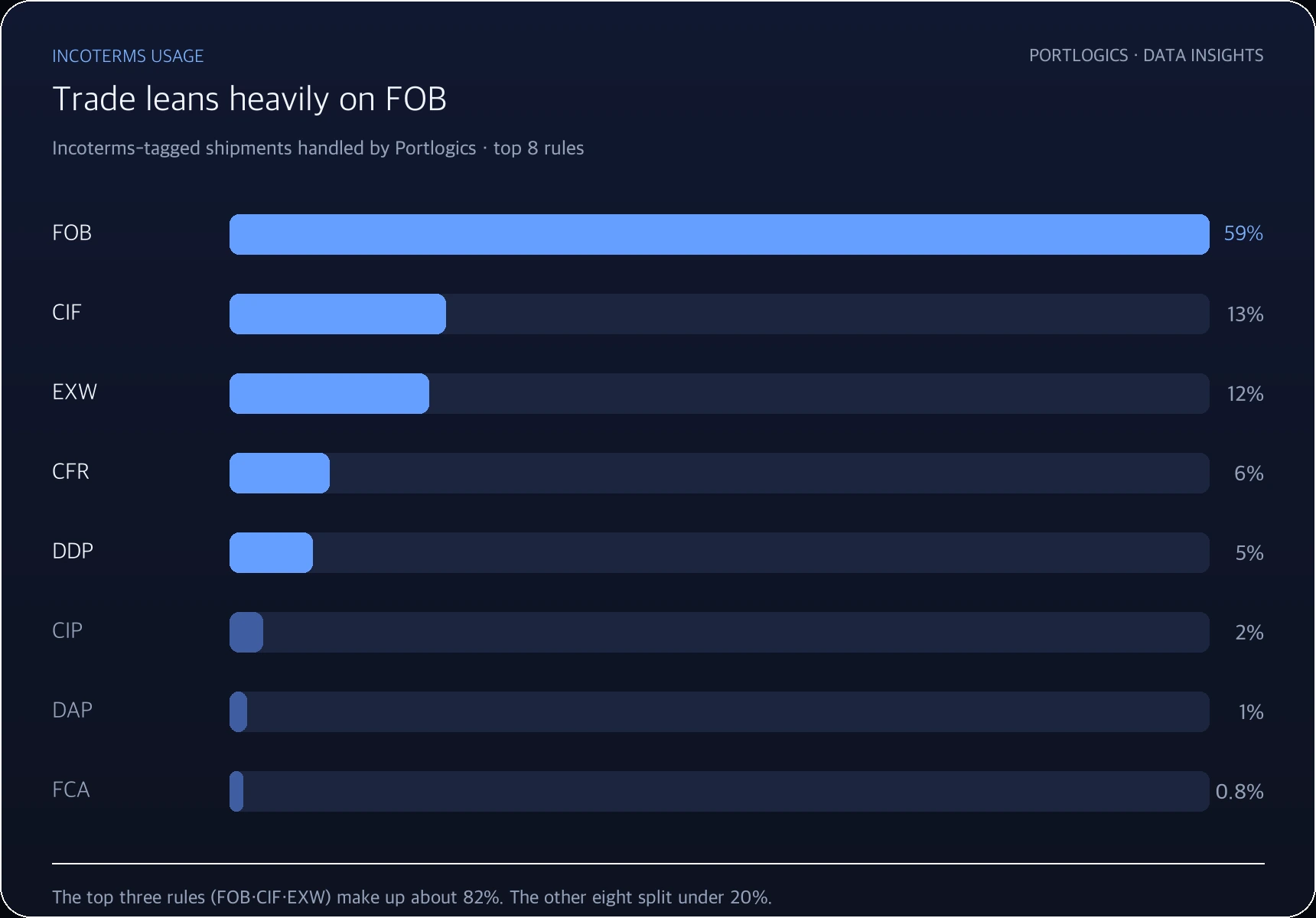
The chart below aggregates the Incoterms-tagged shipments Portlogics handled directly, 10,000 or more in total.
| Rule | Share | Main direction |
|---|---|---|
| FOB | 59% | Imports |
| CIF | 13% | Mixed |
| EXW | 12% | Imports |
| CFR | 6% | Imports |
| DDP | 5% | Exports |
| CIP | 2% | Exports |
| DAP | 1% | Exports |
| FCA | 0.8% | Mixed |
| Other (CNF·DDU, etc.) | 2% | Exports |
FOB alone accounts for 59% of shipments. Add CIF (13%) and EXW (12%) and the top three rules cover 8 in 10 shipments. The remaining eight rules split the other 20%.
Not just our data: national statistics point the same way
One company's data invites the question, "isn't this company just unusual?" So we placed it next to national trade statistics.
A study analyzing trade statistics and a survey together (Kim & Park, 2020) found that in Korea, FOB·CFR·CIF are used 52 to 58 percentage points more than FCA·CPT·CIP, and these rules see higher usage in imports than exports.
Portlogics's own data (FOB 59%, FCA 0.8%, and the import skew of FOB shown below) points in exactly the same direction as this national pattern. In other words, the concentration in our data is not one company's exception but the structural inertia of Korean trade practice.
FOB dominates, but mostly on imports
FOB is often thought of as a seller's rule, but split by direction, the shipment data says the opposite.
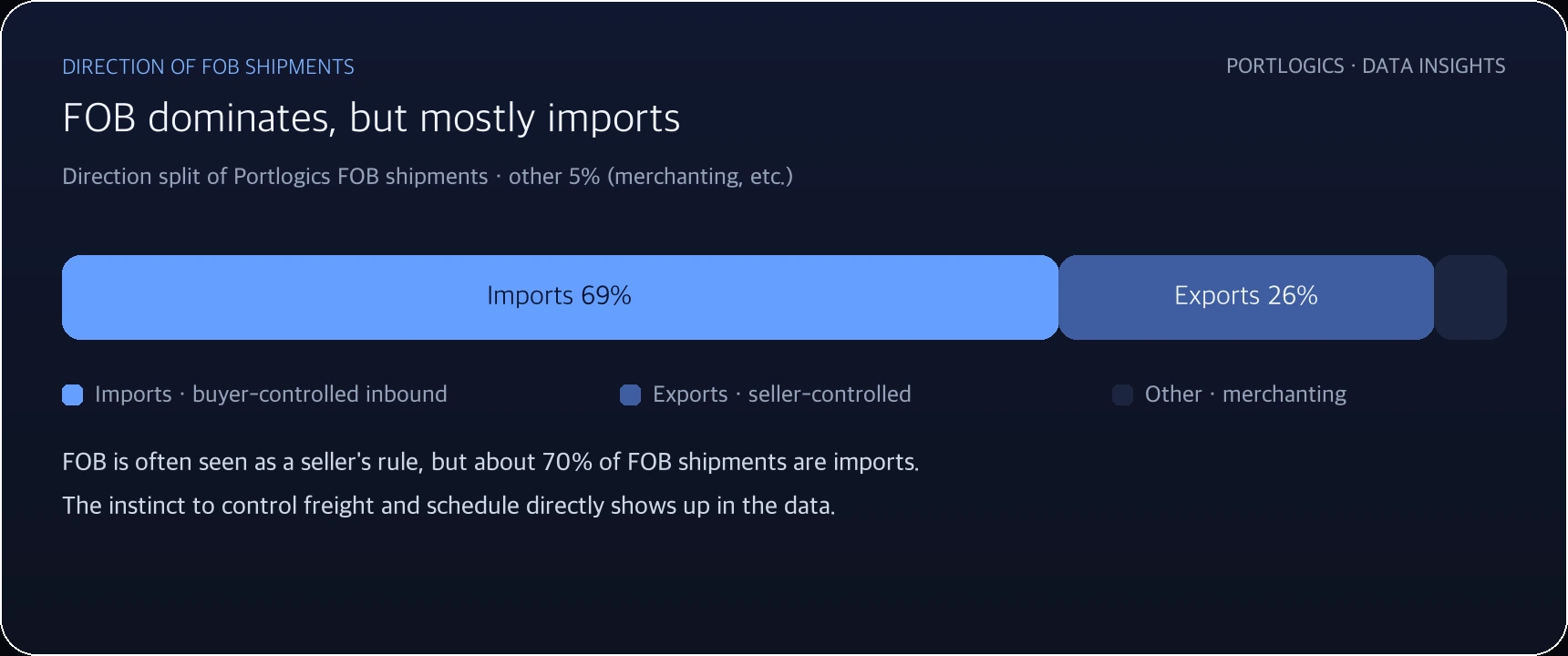
About 70% of FOB shipments are imports. Korean importers buy on FOB to control inbound transport themselves. The instinct to manage freight and schedule directly shows up plainly in the data. For what FOB is and how it differs from CIF, see FOB vs CIF.
The container trap, visible in the data
The ICC and practitioners have long recommended FCA over FOB for containerized cargo. Containers are not loaded directly on board but handed to the carrier at the terminal or CY, so FOB's on-board basis puts the moment risk transfers out of sync with the actual delivery.
Yet in the data, FOB is used about 78 times as often as FCA. The gap between recommendation and practice is right there in the numbers: many container shipments are still handled on FOB out of habit. For why FCA is the accurate rule for containers, see FCA vs FOB; for the full map of all 11 rules, see the complete Incoterms 2020 guide.
Retired terms still in use
The data also held terms that no longer exist in Incoterms or were never official. DDU was removed in Incoterms 2010 and no longer exists; CNF (C&F) is an old informal spelling of CFR. Together they still account for about 2% of contracts. Retired or informal terms can be read differently in a dispute, so it is safer to use the current Incoterms 2020 wording: DAP instead of DDU, CFR instead of CNF.
So which rule fits your trade
The most-used rule is not necessarily the right one for your deal. The answer depends on transport mode, your role, and how far responsibility runs. Find the rule that fits your cargo and trade with the Incoterms selector in a few questions, or let us work through it with you if the terms are unclear.
How this was compiled: we aggregated, by rule, the Incoterms-tagged shipments Portlogics handled directly (excluding other forwarders and test data on the platform). Individual amounts and shipper identities are not included, and counts are shown only as a floor and as shares. Shares are rounded. The national comparison draws on Kim & Park (2020, 2018 trade statistics and survey). This is general information; the right rule for a specific deal depends on the individual contract and negotiation.
Interactive tool
Interactive Incoterms comparison tool
Break down the cost of all 11 rules by import/export direction across segments, with risk-transfer points and linked HS code, duty, and freight calculators, all on one screen.
Frequently asked questions
Which Incoterm is used most in Korea?
Across 10,000 or more real shipments Portlogics handled, FOB was the most used at about 59%, followed by CIF (13%) and EXW (12%). The top three rules make up about 82%. National trade statistics show the same tendency, with FOB·CFR·CIF used far more than FCA·CPT·CIP.
Isn't FOB a rule for exports?
It is often thought of that way, but in the shipment data about 70% of FOB shipments were imports. Korean importers buy on FOB to control inbound transport (freight and schedule) themselves.
Can I use FOB for containerized cargo?
It is common but not technically correct; FCA is the accurate rule. Containers are handed to the carrier at the terminal or CY rather than loaded on board, which misaligns with FOB's risk-transfer basis. In the data, FOB is used about 78 times as often as FCA, showing a wide gap between recommendation and practice.
Does this represent all of Korean trade?
These figures are based on shipments Portlogics handled. That said, national trade statistics (Kim & Park, 2020) also show the dominance of FOB·CFR·CIF and their higher use in imports, so the direction matches the national pattern.


