
What Is a WMS? Warehouse Management System vs Inventory Software, ERP and TMS

Manage inventory in spreadsheets, and as the warehouse grows you lose the real-time view of what is where and how much. Mispicks and stock discrepancies pile up, and you end up relying on memory and gut. A WMS solves that with a system.
This guide helps teams standardizing warehouse and inventory operations understand what a WMS does and decide whether to deploy one or outsource.
What is a warehouse management system?
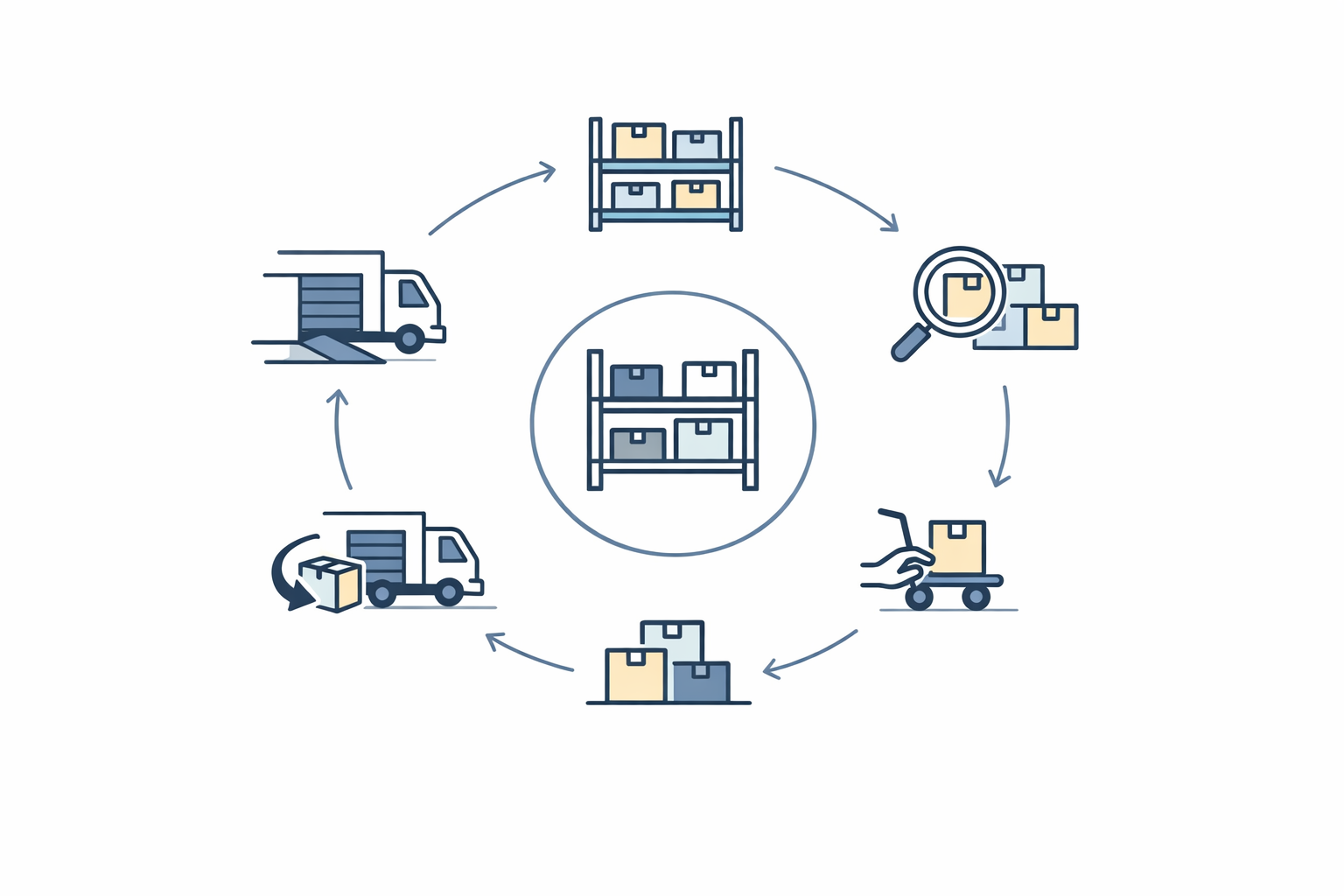
A WMS (Warehouse Management System) manages every task inside the warehouse, from inbound to storage, inventory, picking, shipping, and returns. It tracks what is where and how much in real time, and issues work instructions to standardize warehouse operations.
WMS vs ERP vs TMS
Warehouse-related systems are easy to confuse. Splitting them by scope makes the boundaries clear.
| WMS | ERP | TMS | |
|---|---|---|---|
| Manages | Warehouse tasks and inventory | Company-wide resources (accounting, purchasing, stock ledger) | Transport outside the warehouse |
| Answers | "What is where, and how much?" | "How do company resources flow?" | "Where is my cargo, and when does it arrive?" |
| View of stock | Physical stock by location | Ledger quantity and value | Cargo in transit |
Where ERP stock is "how much on the books," WMS stock is "how much sits physically in rack A, bin 3." As covered in the TMS (transportation management system) guide, a WMS and a TMS split roles inside and outside the warehouse and complement each other.
Is inventory software the same as a WMS?
No. Inventory software answers "how many of this do we have." A WMS also answers "where is it, and in what order should it be handled."
| Inventory software | WMS | |
|---|---|---|
| Stock unit | Quantity per SKU | Physical quantity per location |
| Work instructions | None; people decide | Generates inbound, pick and outbound tasks |
| Scope | Records receipts and issues | Every operation inside the warehouse |
| Fits when | Few SKUs, simple storage | Multiple racks, zones and pickers |
If the only requirement is that quantities reconcile, inventory software is enough. The break point is when one SKU sits in several locations and more than one person picks it. Once stock counts are right but staff cannot find the goods, or older lots ship after newer ones, a receipts-and-issues ledger no longer solves it.
What does a WMS manage inside the warehouse?
A WMS unifies scattered warehouse work into:
- Inbound: verifying expected receipts, inspection, and location assignment
- Storage and locations: assigning and tracking item positions by rack and bin
- Inventory management: real-time quantities, expiry and lot tracking, cycle counts
- Picking and packing: optimizing pick paths for orders and packing
- Outbound: inspection, loading, and handoff to carriers
- Returns: inspecting returned goods and restocking or disposing
What changes after you deploy a WMS?
- Inventory accuracy: reduces the gap between physical stock and data, preventing mispicks and stockouts
- Space efficiency: improves storage density and pick paths through location optimization
- Standardized operations: shifts warehouse work from memory-based to instruction- and verification-based
- Visibility: real-time view of inventory and task status speeds up decisions
When do you actually need a WMS?
A volume threshold is the wrong test, because the same throughput behaves differently depending on the goods and how they are stored. Treat it as a question of whether spreadsheets and manual handling have run out. The signals:
- Every stock count turns up the same gap between the book figure and the shelf
- Quantities reconcile, but finding the goods takes real time
- Expiry dates or lots need tracking and first-in-first-out is not holding
- Mispicks and shortages are rising, with no record that explains why
- Headcount has grown and handover depends on what people remember
Two or three of these together is a systems problem. Adding staff reproduces the same errors.
Should you build a WMS or run on a 3PL system?
You can build a WMS in-house or use a 3PL and fulfillment provider's system.
- In-house: better control and unit cost when the warehouse and volumes are large and steady, but heavy build, operation, and staffing burden.
- Outsourced (3PL): place your inventory on the provider's WMS and get standardized warehouse operations without the system investment. Better when volumes are volatile or you lack your own infrastructure.
What should you check when choosing a WMS?
- Accuracy and real-time: does stock update in real time, and does it reduce count variance?
- Integrations: does it connect to ERP, storefronts, TMS, and carriers?
- Scalability: does it flex as volumes, SKUs, and channels grow?
- Fit to the floor: does it match how the site actually works (barcodes, mobile)?
This guide is for general information. Actual features and deployment vary by product and operating environment. Confirm with a consultation.
Frequently asked questions
What is a WMS (Warehouse Management System)?
Software that manages every task inside the warehouse, from inbound to storage, inventory, picking, shipping, and returns. It tracks what is where and how much in real time and issues work instructions to standardize operations.
How is a WMS different from an ERP?
Where ERP stock is a ledger quantity and value tied to accounting and purchasing, a WMS manages physical stock by location, down to which rack and bin holds how much. A WMS runs the warehouse floor; an ERP runs company-wide resource flows.
How is a WMS different from a TMS?
A WMS manages storage, inventory, and picking inside the warehouse; a TMS manages transport outside it. A WMS answers 'what is where and how much,' a TMS answers 'where is my cargo and when does it arrive.' They complement each other inside and outside the warehouse.
Should I deploy a WMS in-house or outsource?
In-house gives better control and unit cost when warehouses and volumes are large and steady, but carries a heavy build and operating burden. If volumes are volatile or you lack infrastructure, using a 3PL and fulfillment provider's WMS gives standardized operations without the system investment.

